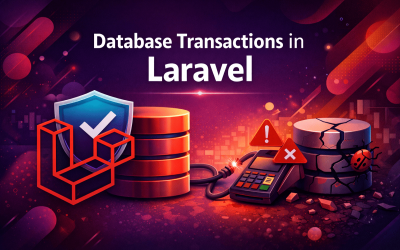
Database Transactions in Laravel to Protect Data Integrity

Saleh Megawer
Full Stack Web DeveloperWhy Data Integrity Is a Critical Issue
In real-world Laravel applications, the most dangerous problems are not obvious bugs or visible errors. The real threat is silent data corruption that happens without anyone noticing.
Your application may look perfectly fine, users are active, and everything appears stable, while internally the database is slowly drifting into an inconsistent state.
Data integrity means that your system state always reflects reality. Once this principle is broken, long-term damage is almost guaranteed.
The Common Mistake in Laravel Applications
Many Laravel developers write code like the following and feel confident that it works correctly. In most cases, it even passes testing without issues.
public function subscribe(User $user)
{
    // Create subscription
    $user->subscriptions()->create([
        'plan'   => 'premium',
        'status' => 'active',
    ]);

    // Charge credit card (external API)
    Stripe::charge($user->id, 100);
}
At first glance, this code makes perfect sense. A subscription is created, then the payment is processed.
The problem is that these two operations rely on completely different systems. Your database is under your control, but the external payment gateway is not.
The Silent Failure Scenario
Let’s walk through what can realistically happen in production.
The user clicks the subscribe button. Laravel successfully creates the subscription record in the database. Immediately after that, the payment request to Stripe fails.
The result is a critical inconsistency. The subscription exists and is marked as active, but no payment was ever completed.
No visible error appears. The application keeps running normally. Yet the system state is now incorrect.
These are the most dangerous bugs because they can live in production for months before being discovered.
Why This Code Is Dangerous Even Though It “Works”
The issue is not PHP or Laravel. The issue is architectural thinking.
These operations must be treated as a single atomic action, not as independent steps.
Once you allow each step to succeed or fail on its own, you break a fundamental system design principle: either everything succeeds, or nothing does.
What Are Database Transactions?
A database transaction allows multiple operations to be executed as a single unit.
If any step fails, the database automatically rolls back to its previous state, as if the operation never happened.
This guarantees that your database always remains consistent, even when unexpected failures occur.
The Correct Solution Using Transactions in Laravel
Laravel provides a simple and powerful way to handle this problem.
DB::transaction(function () use ($user) {

    $user->subscriptions()->create([
        'plan'   => 'premium',
        'status' => 'active',
    ]);

    Stripe::charge($user->id, 100);
});
This changes everything.
If the payment fails, Laravel automatically rolls back the database changes. The subscription record is removed as if it never existed.
How Laravel Handles Rollbacks Automatically
Any exception thrown inside the transaction closure triggers an automatic rollback.
You do not need to manually clean up data or write complex error-handling logic.
This results in cleaner code, better maintainability, and significantly safer production systems.
When Should You Use Database Transactions?
Transactions should be used for any operation involving payments, subscriptions, balance deductions, or multiple related database writes.
If a failure can lead to financial loss or corrupted business logic, a transaction is not optional.
Common Mistakes When Using Transactions
One common mistake is placing long-running or unrelated logic inside a transaction.
Transactions should be short, focused, and limited to critical database operations only.
Final Thoughts
Database transactions are not an optional feature. They are a fundamental requirement for any serious Laravel application.
Code that “works” is not necessarily safe. Ignoring data integrity always leads to problems, usually when it is already too late.
Use transactions. Protect your data. Protect your system.